





1. Trap the Cat Game Overview
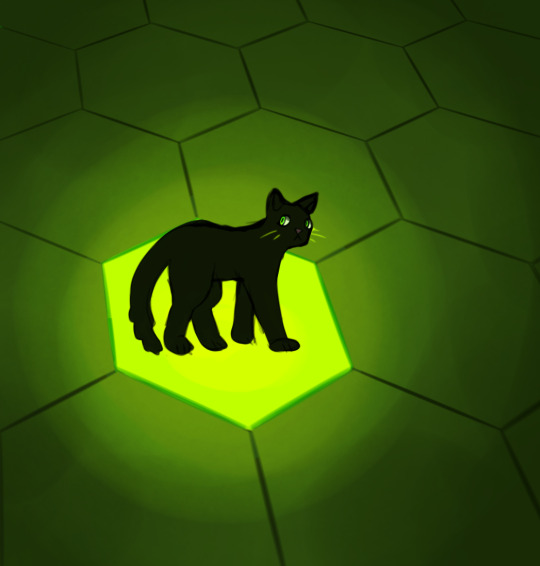
Trap the Cat is a turn-based strategy puzzle played on a field of hexagonal tiles. A cat begins near the center and wants to reach any outer edge. On each turn, the player blocks one empty tile; the cat then moves one step along a route it believes leads toward escape. The player wins only when every possible path is sealed and the cat has no legal tile to enter.
The rules are minimal, but the cat's movement makes the puzzle difficult. Blocking the square directly ahead may send it toward a shorter route on the opposite side. Randomly placed dark tiles already exist at the start of a round, creating a new strategic landscape each time. Those barriers can become the foundation of an enclosure if the player connects them efficiently.
Trap the Cat rewards planning outward rather than chasing the animal one step at a time. A broad ring gives room to react, while a narrow last-second wall is easily bypassed. There is no time limit, so players can examine the shortest paths, compare multiple escape directions, and choose one blocking tile deliberately. No fixed solution works for every randomized board. That variety makes the game a compact test of pathfinding, prediction, and resource efficiency. It is ideal for logic fans who enjoy quick rounds and for casual players who want a puzzle that can be learned instantly but resists careless play.
Key Details:
| Genre: | Strategy / Pathfinding Puzzle |
| Difficulty Level: | Medium to Hard |
| Average Play Time: | 2–8 minutes |
| Best For: | Logic solvers, strategy learners, and fans of short replayable puzzles |
2. How to Play Trap the Cat
Getting Started:
- Study the cat's position, the outer edge, and all pre-blocked dark tiles.
- Click or tap one open hexagon to turn it into a barrier.
- Watch the cat move one step toward an available escape route.
- Build connected barriers that reduce several routes at once.
- Seal every adjacent option before the cat reaches the edge.
Basic Controls:
- Mouse: Click an empty hexagonal tile.
- Touchscreen: Tap a tile to block it.
Objective: Prevent the cat from reaching any edge cell by surrounding it with blocked tiles.
3. Trap the Cat Features & Highlights
- ✓ One-tile turns create a clear strategy problem without complex controls
- ✓ Pre-blocked cells make every starting board different
- ✓ Cat pathfinding reacts to each decision and punishes weak barriers
- ✓ No timer allows careful route analysis
- ✓ Quick restarts make failed plans useful learning opportunities
4. Trap the Cat Tips & Strategies
Beginner Tips:
- Begin several tiles away from the cat instead of blocking only its current direction.
- Connect new barriers to pre-blocked cells whenever that closes more space.
- Count the cat's shortest distance to each open edge.
Advanced Strategies:
- Block tiles that belong to several possible escape paths at once.
- Shape a wide incomplete ring, then close its most urgent gap.
- Steer the cat toward a region where random barriers already create a dead end.
What to Watch Out For:
- Building one wall can leave the opposite side completely open.
- Blocking adjacent tiles too early may simply guide the cat toward the nearest edge.
5. Trap the Cat Game Elements Explained
Hex Grid and Barrier Placement: Hexagonal tiles have six neighbors, giving the cat more directional options than a square-grid piece. Each player turn permanently changes one open tile into an obstacle. Because only one barrier can be added before the cat moves, placement must affect future routes rather than merely the current square. Pre-blocked tiles are free structure. Two isolated obstacles may need only one or two connecting moves to become a useful wall, while building in an empty region consumes many turns. Start by identifying which outer sectors already contain barriers and which route gives the cat the fewest steps to freedom. Place new blocks at junctions where several paths pass through the same tile. A connected arc is stronger than scattered dots because the cat cannot weave between it. Still, the enclosure needs enough distance for completion. If the wall is built directly beside the cat, each move may open a new direction faster than it can be sealed. Use space as planning time and let the barrier network gradually reduce the accessible region.
Cat Pathfinding and Enclosure Strategy: After every block, the cat chooses a legal move toward an edge, generally favoring a short available path. Its response reveals which escape route remains attractive. Do not assume it will continue straight; a newly blocked tile can cause an immediate turn toward another opening. Think of all open tiles as a network. The goal is to disconnect the cat's current region from the outer boundary. A complete enclosure wins even if it is large, so surrounding an area is often easier than trying to trap the cat on one exact cell. Use each movement as information: if the cat turns toward a barrier-rich sector, reinforce that side and prepare to close behind it. If it accelerates toward a clear edge, block farther ahead at a junction rather than directly in front. When several edge paths remain, prioritize the one requiring the fewest cat moves. The strongest turns reduce the number of reachable edge routes, not just the distance traveled in the next step.
6. Trap the Cat Frequently Asked Questions
Q: How do I place a barrier?
A: Click or tap any unoccupied hexagonal tile. It turns dark and the cat then makes its move.
Q: What should I do if the cat is already close to the edge?
A: Block the most important junction ahead of it and check whether nearby pre-blocked tiles can form an emergency wall. Some positions may already be unsalvageable.
Q: Is Trap the Cat compatible with mobile and desktop browsers?
A: Yes. The source lists mouse click or tap as the controls.
Q: Can I save my progress?
A: Rounds are short and generated for immediate play. The original page does not describe saving a board in progress.
Q: How do I unlock new boards or levels?
A: The source emphasizes replayable boards with no fixed solution rather than a formal unlock tree. Start a new round to receive another arrangement.